
Gil Even-Tsur AIA
Architecture is experienced from the inside as much as it is understood from the outside. The quality of a building ultimately depends on the continuity between its exterior form and the spaces within.
For much of architectural history, there was little distinction between architecture and interior design. Architects conceived buildings as complete works, considering every scale of the project—from the urban presence of the building to the proportions of a room, the way daylight entered a space, the choice of materials, and the smallest crafted detail. The architecture did not stop at the building envelope; it extended naturally into the spaces people inhabited.
Arne Jacobsen exemplified this way of working. His buildings, interiors, furniture and lighting were never treated as separate disciplines, but as different expressions of the same architectural idea. The result was an uncommon sense of coherence, where every element contributed to a unified experience.
This tradition continues to shape our practice.
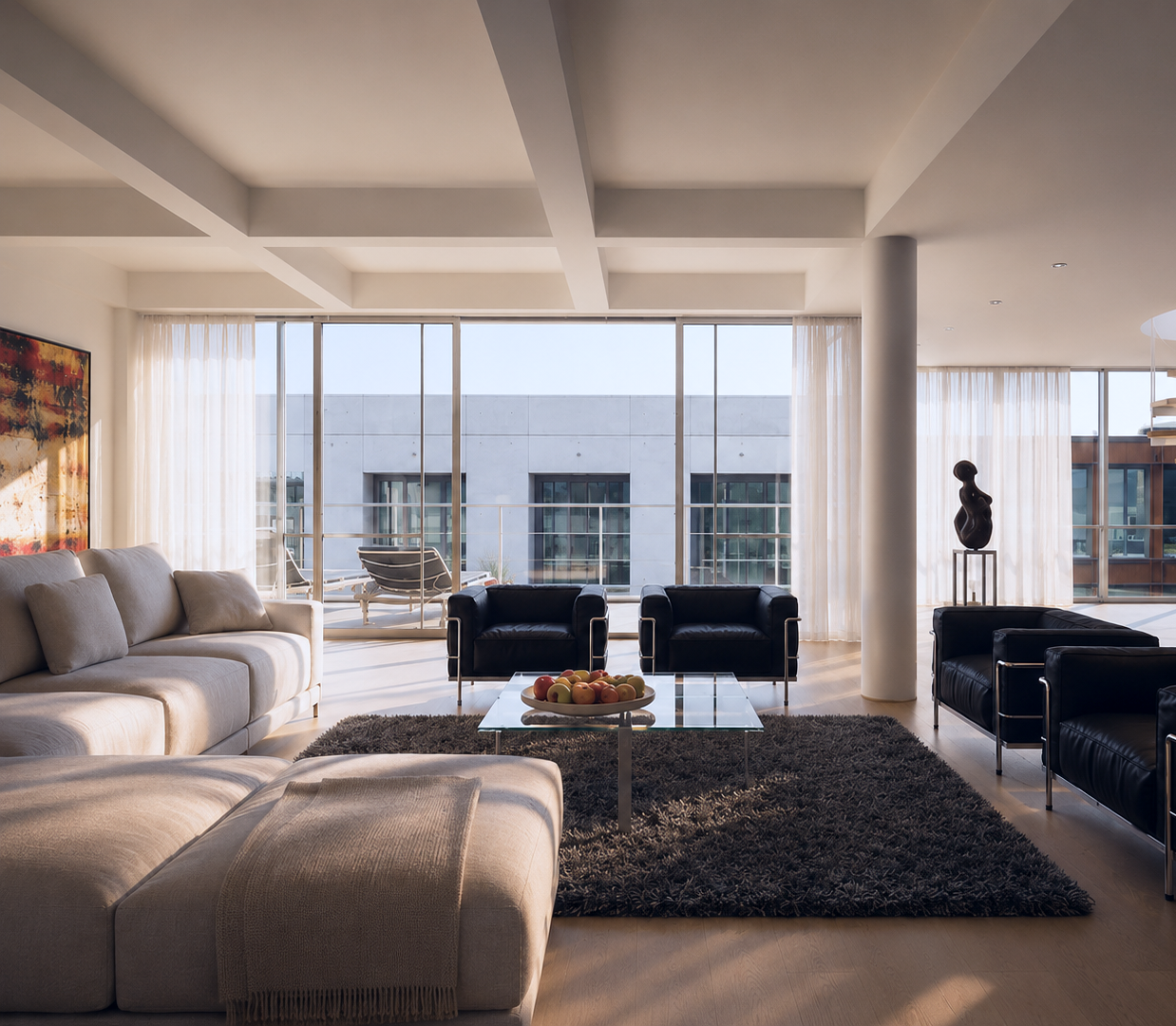
For many years, we have designed interiors alongside architecture for residential developments, adaptive reuse projects and private homes throughout New York. During my years at Richard Meier & Partners, I had the opportunity to work on projects such as 165 Charles Street, where architecture and interiors were conceived as one continuous design process. The clarity of the architectural concept was carried through to every apartment, creating interiors defined by light, proportion and a quiet sense of permanence.
That experience reinforced a belief we have carried into our own work: the strongest architecture emerges when the building and its interiors are developed together from the very beginning.
Designing both allows every decision to reinforce the central architectural idea. Materials establish a continuous language between inside and out. Openings are positioned not only to shape the façade, but to frame light and views from within. Structure, services and detailing become opportunities to simplify rather than compromise the architecture. The interior is not an independent layer applied after the building is complete—it is an essential part of the architecture itself.
For developers, this integrated approach creates projects with greater clarity, consistency and lasting value. It strengthens a building's identity, streamlines the design process, and ensures that the qualities expressed by the architecture are fully realized in the spaces people experience every day.
We continue to believe that architecture and interiors are inseparable. Together they create places that are not only well designed, but deeply coherent, enduring and memorable.